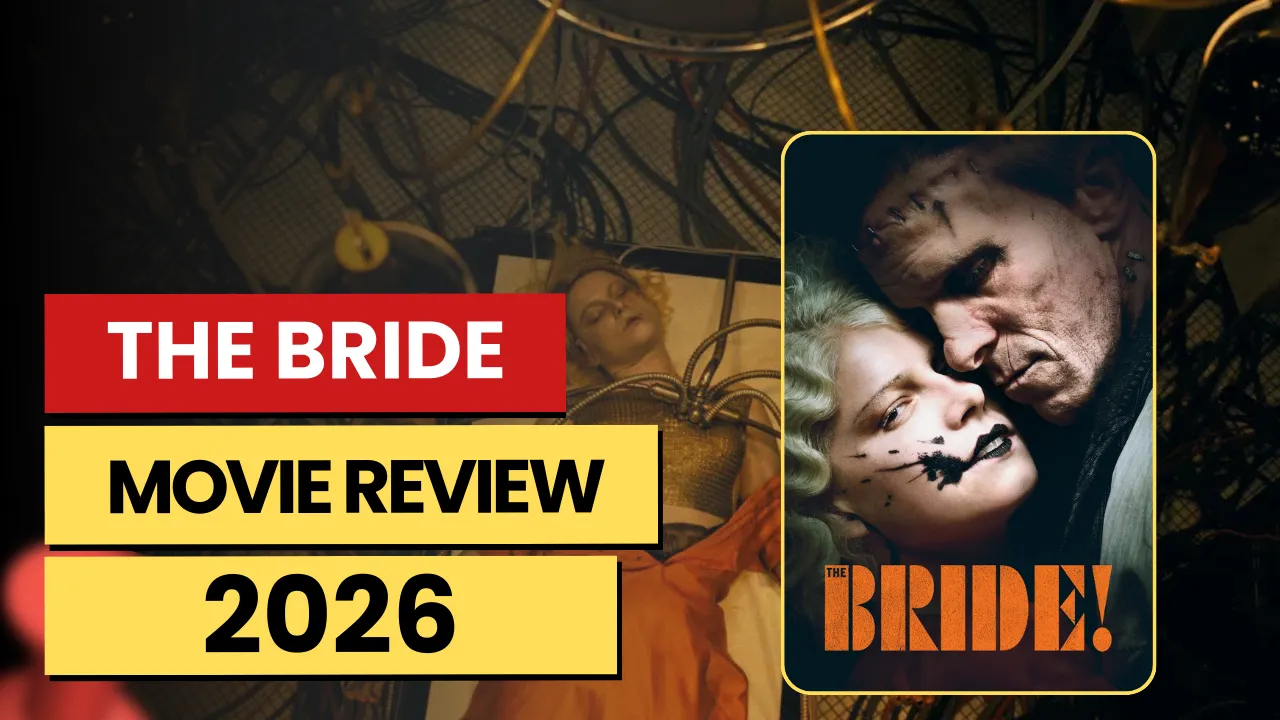
A lot of people out there saying this is what Joker: Folie à Deux wishes it was. Can I do this video without making that comparison? I'll try. To be fair, the movie makes it quite difficult to do.
So, Joker: Folie à Deux. There it is.
THE BRIDE is writer-director Maggie Gyllenhaal's stylistic take on the Bride of Frankenstein. Takes place in 1930s America. Frankenstein, played by Christian Bale—which I'm just going to call him Frankenstein for the sake of time because one, he adopted his father's name, so he goes by Frankenstein or Frankie. Two, ironically, the one we call Frankenstein's monster in the story of Frankenstein is not actually the monster in the story of Frankenstein. So let's start seeing with our hearts instead of our hate. Okay.
But he wants a bride. He's suffering from loneliness. Apparently, the dating pool for a monster in 1930 is a lot like the dating pool in 2026. So he finds a doctor played by Annette Bening. Together, they dig this dead girl up, bring her to life, and now we have this weird stylistic acid trip: Bonnie and Clyde with a couple more monsters and a lot more feminism.
The Performances
First of all, out the gate, Jesse Buckley is incredible in this movie. I mean, her and Christian Bale are both great. I was wondering if it was going to be, you know, the Christian Bale show, but with more stitches. But the way he draws out his words, grunts at times—you can tell he's still mentally young, though he's over a hundred at this point. When he's frustrated and has those power grunts, I was like, that is the Frankenstein I remember.
But Jesse Buckley? It is absolutely the Jesse Buckley show.
The Stylistic Choices
Because Maggie Gyllenhaal does a—we'll call it stylistic choice. It's what I thought was going to be a weird thing in the movie. It is a weird thing. Allow me to explain.
From the get-go—the opening, the first line spoken in the film—the film establishes that Mary Shelley is talking through the bride character. Not always, just at times. So Jesse Buckley acts one way as the bride and then will randomly just snap into this totally different accent, have this completely different vibe about her, and then snap back. Only thing is, the characters in the film recognize it—like, what's wrong with her? Why is she sounding like that? Why is she talking like that?
It reminded me of River Tam in Firefly—the way she would just talk nonsense and no one really knew what she was saying, only if River spoke with an accent other than just Badger. She has these flashes of which Mary Shelley is speaking through, and then she snaps back and talks like herself.
So Mary Shelley, who wrote Frankenstein—in which this bride movie is a stylistic spin-off adaptation extension of—is speaking through the character in a capacity that's more than just, well, the character speaks the author's words. It's the author as a character entity speaking through this woman at times. Breaking the fourth wall is huge right now. Thanks, Deadpool. Pretty sure we just smashed the fifth.
All that is to say, I thought it was going to be this element that just stood out like a sore thumb. Like, I didn't need that in this movie. Just give me the story of the bride and Frankenstein. But Jesse Buckley clocked in such a strong performance and sells it. And I never questioned it.
This movie does have these stylistic choices that you think are not going to work that actually do work. Also has things where you're like, what was the point of that? But for the first half of this movie, I was digging it. This weird monster love story/Bonnie and Clyde thing they had going on.
The Elephant in the Room
An ironic elephant, because Joker: Folie à Deux and The Bride are both Warner Brothers. Was Warner Brothers like, "Hey Todd, hey Maggie, you do it this angle, you do it that angle. We'll see whose monsters do it better"? Don't know. But the answer is The Bride.
The Dance Sequence
Frankie really loves movies in here, and he sees himself and her in the films, talking it out. He also sees himself in these dance sequences. There's a dance sequence that happens in which everyone joins in like it's a flash mob and no one really questions it. And the dance sequence served a purpose. That's the most important thing. It started raising the tension. You felt like this dance sequence is going to lead to trouble. And it does. It's not just a dance sequence that's there 'cause.
The Second Half Problems
Then the second half of the movie happens. It just gets a lot messier.
We spend more time with these two detectives played by Penelope Cruz and Peter Sarsgaard. I always want to call him Skarsgård, but Sarsgaard is not Skarsgård. They are different. And at first I dug the fact that, okay, these are the normal people's eyes looking in on this monstrous situation. Then at a point I was like, this is a storyline that is just padding the runtime of this film.
There's this side arc about this mob boss who takes women's tongues. Him taking women's tongues—maybe it's an allegory about the patriarchy taking their voice, maybe. But it's just sloppy. It goes nowhere for the sake of the film. You could take that whole mobster thing out. Maybe you'd have to tweak a couple things for the resolution of the film, but you'd also save yourself 15 solid minutes of wasted time.
Another Joker Comparison
There's that. There's this—another Joker comparison doesn't stop at Folie à Deux. No, we're going back to the original Joker movie now. Joker killed the guys in the subway and then inspired guys like, "Hey, let's put on Joker masks and clown masks and let's go out there and let's start raising hell." It's like that, but you know, in 1930 with female empowerment—in which women start painting the design on the bride's face on their faces and they start going out there and killing dudes.
I guess I can tell you that arc in the movie because it's not actually an arc. It's a thing that happens, is shown, and then stops—never to be seen or spoken of again—just taking up screen time. And by screen time I mean you could leave it in. It's not going to save you 15 minutes. It's going to save you 15 seconds. It just kind of goes nowhere.
And the movie does start getting repetitive. You know, there's a slew of douchebags in this movie. We saw the dudes in the trailer attacking her and then Frankie beats him down and kills him. But in case you blinked, took a bathroom break, and or missed it—if you need more rapey guys coming after her, that happens again. If it wasn't clear by now, yeah, the movie could have been shorter. Should have been shorter.
Final Verdict
Look, in the end, this movie felt like Baz Luhrmann threw up on Gotham, and it was kind of cool. And for the first half, I was digging it. Jesse Buckley and Christian Bale were both great. Jesse Buckley stealing the show here. But by the end, it felt like cinematic spray and pray. Like Maggie Gyllenhaal was just shooting the entire wall. And well, you're bound to hit a couple of targets. Sure. However, on the other hand, behold some of the misses.
And I'm sure the movie's going to get a hip-hip-hooray or two from some of the feminists watching it in the audience. The male feminists that is—you know, the ones that clap at everything, try too hard while they're on their date. Yeah, that was—
You're not clapping. Oh, you're a fan of characters and side arcs that make sense and have payoff? This is awkward.
Now, in the end—Joker: Folie à Deux—I'll say it's worth watching when it comes out on streaming. Then halfway through, just stop there.
So, The Bride—have you seen it? What did you think about it? What's your favorite movie in which you're rooting for the monsters or the bad guy? Whatever it is, whatever you think, comment below. Let me know. And as always, if you like what you've seen here and you want to see more, click right here to see more.
No comments yet. Be the first to comment!