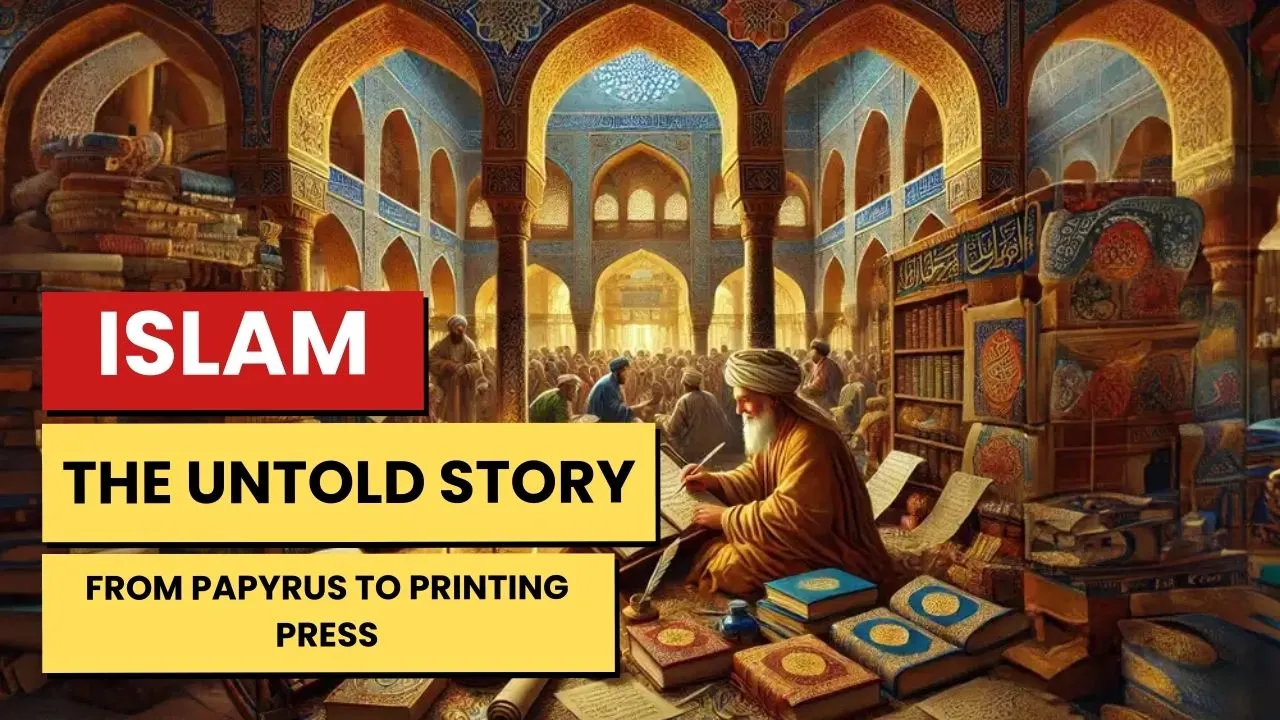
When we make any video about Jangi-Jung-e-Bad, Jerusalem, Israel never leaves its support. I love it. One question people ask again and again: What is the source of all this? Where do you get all this from? No, brother, what is the source of all this? Here is our source. Rather, this is not just our source, but the source of all Islamic history. These are the books. Tareekh Tabari. Ibn-e-Aseer, Ibn-e-Kaseer, and Ibn-e-Khaldun, and many other books as well. Almost the entire world considers these very books as the history of Islam.
But in my opinion, an even bigger question should be: what is the source of these books of Islamic history? And where did all these big books come from? The story of these books and the scholars who wrote them is very interesting.
1400 Years Ago: The Era of the Sahaba
1400 years ago, after the passing of Rasulullah (Sallallahu Alaihi Wasallam), his first caliphs—Abu Bakr, Umar, Usman, and Ali (Radi Allahu Anhum)—did not write any history of Islam because there was no need to write it. Most of the Sahabah (companions) were still alive and already knew all the history of Islam.
The Need for History Arises
But gradually, as the Sahabah began to leave this world, the new generations of Muslims started forgetting the history of Islam, the battles like Badr, Uhud, and Khandaq. Some young people, instead of being inspired by the heroes of Islam like Khalid bin Walid and Ali (Radi Allahu Anhum), started getting impressed by the heroes of the Roman and Persian Empires, Heraclius and Rustam.
The First Effort: Umar bin Abdul Aziz
Now, to remind this young generation of the heroes of Islam, a very great Caliph of the Muslims started the work for the first time. His name was Umar bin Abdul Aziz. As soon as he became Caliph, Umar bin Abdul Aziz called a great scholar of that time, Ibn-e-Shihab Zuhri, and ordered him: "During my caliphate, go everywhere and give lectures to Muslims about the life of Rasulullah (Sallallahu Alaihi Wasallam)." By the time of Umar bin Abdul Aziz, only a few of the last Sahabah were alive in the world. So Ibn-e-Shihab learned about the life of Rasulullah (Sallallahu Alaihi Wasallam) from them and started teaching it to his students, so that future Muslims would not forget these great heroes of ours. Among these students, two are known to the entire world today: Ibn-e-Ishaq and Imam Malik. After this, Ibn-e-Shihab wrote the very first book on the history of Islam.
The Book is Lost
But as soon as he completed this book, Caliph Umar bin Abdul Aziz was martyred. And within just 30 years of Umar bin Abdul Aziz's martyrdom, the entire Umayyad rule collapsed. And along with the Umayyads, the first book on the history of Islam, written by Ibn-e-Shihab, also disappeared from the world.
The Abbasid Caliphate and the Love for Knowledge
Now, the Umayyad Caliphate was gone, but a new Caliphate began in the world: the Abbasid Caliphate. The Abbasid Caliphate, like the Umayyads, also had many flaws. But there was one thing about them that no one can deny: the Abbasids loved knowledge (ilm) so much that they could go to any extent to acquire it. To the extent that an Abbasid king ended a very big war with the Roman Empire just in exchange for a book by Plato.
The House of Wisdom (Bait-ul-Hikmah)
The Abbasid Caliph, Mansur, destroyed the Umayyad capital and built a new capital for Muslims in the world: Baghdad. And inside it, he built the world's largest library, which later became known as Bait-ul-Hikmah (the House of Wisdom). As soon as this library was built, the Abbasid Caliph Mansur called the same Ibn-e-Shihab Zuhri's student, Ibn-e-Ishaq, and ordered him: "Go and write a book on the history of Islam again. But not just any ordinary book. It should contain the history of the entire world, from Adam (Alaihis Salam) to me." Ibn-e-Ishaq did exactly that and, on Mansur's orders, wrote the first complete history (Tareekh) of the Muslims. This was not a book of Hadith but a book of history. However, today, this important book of Ibn-e-Ishaq has also disappeared from the world.
The Problem: No Paper Technology
But now the question is, why were all these books disappearing from the world? Because until then, Muslims did not know the technology of paper. And all these books were written on a very expensive material of the old times called papyrus, which Muslims used to make by joining these small leaves together. It was a very difficult task compared to paper. In those times, the technology of paper existed in only one country in the world, far away from the Muslim Caliphate: China. And the emperors of China had kept this paper technology hidden from the entire world.
The Battle of Talas and the Secret of Paper
But this was all about to change soon. Because shortly after the advent of the Abbasid Caliphate, the biggest battle took place between the Muslims and the Chinese Empire, in which the Muslim army easily crushed the entire Chinese army and captured thousands of Chinese soldiers. Now, it is said that among these Chinese prisoners, there were some people who knew the technology of making paper well. And from this point, for the first time, Muslims began to learn the technology of making paper from these Chinese prisoners. But initially, Muslims didn't know much about its importance.
Harun Rashid and the Paper Factory
Then finally came the greatest king of the Abbasid Caliphate, whose name was Harun Rashid. And Harun Rashid knew well the power of paper technology. That's why he built the world's largest paper-making factory in Baghdad. With this, a new era began in the world that people still remember today: the Islamic Golden Age.
The Islamic Golden Age Begins
Harun Rashid built the world's largest paper factory right next to the House of Wisdom. Where there were water-powered machines. Thousands of papers were made daily. This was the world's largest paper factory. And this was such a big deal that the first paper factory in Europe was built 300 years after the Muslims.
Preservation of Knowledge
Now, because of this paper technology, the worry of books disappearing was over. Because any book written in the House of Wisdom was copied in this paper market and spread throughout the world. That's why during the Islamic Golden Age, scholars everywhere started writing thousands of books. Many of them still exist in the world today. It is said that in that era, scholars were respected as much as Ronaldo or Messi are today.
Major History Books of the Golden Age
It was in this Golden Age that the six major books of Hadith, like Sahih Bukhari and Sahih Muslim, were written. But there was still a big problem: due to the disappearance of Ibn-e-Ishaq's book, there was no complete book on the history of Islam. So seeing this, the same Ibn-e-Ishaq's student, Ibn-e-Hisham, once again wrote a book on the history of Islam, and because of paper technology, this book of Ibn-e-Hisham is still with us today. In fact, you can easily get a new version of this book from anywhere. This is the oldest book on the history of Islam.
After Ibn-e-Hisham, books on the history of Islam started being written everywhere. The next book on Islamic history was written by Al-Waqidi. Here is Waqidi's book. But today, many scholars do not consider some of Waqidi's accounts to be correct. After him, Waqidi's student also wrote a book: Tabaqat Ibn-e-Sa'd, in which he wrote the stories of all the Sahabah.
Tareekh Tabari
And finally, during this period, a book was written that if you know even a little about Islamic history, you must have heard its name. And that book is called Tareekh Tabari. This is Tareekh Tabari. Imam Tabari was a great scholar of the Islamic Golden Age. He used to teach students in a school in Baghdad for a salary of 10 Dinars. But gradually, as people came to know of Imam Tabari's intelligence, it is said that once his school happily placed a treasure of gold dinars in front of him. But Imam Tabari took only his 10 dinars from it and said, "This is my salary. I will not take a single penny more than this." In his book, Tabari has written everything from Adam (Alaihis Salam) to the conditions of the Abbasid Caliphate.
There were many other scholars besides these, but here we are only discussing those who wrote major books on the history of Islam. Tareekh Tabari was the last major book of the Abbasid Caliphate.
The Crusades and Salahuddin Ayyubi
After this, the Abbasid Caliphate gradually began to weaken. Eventually, Muslims became so weak that the Pope of Europe took the biggest advantage of this, gathered the Christians of Europe, attacked the Muslims' Palestine, and occupied Jerusalem. But even after losing Palestine, just like today, Muslim leaders didn't care. The dream of reconquering Palestine was more in the hearts of the scholars of that time than in the Muslim kings. Among them, the greatest scholar was named Imam Ibn-e-Asakir. He was such a great scholar that he has 70 volumes of just one book. Imam Ibn-e-Asakir used to teach Islamic history to students in Damascus and kept telling them that one day Muslims will surely reconquer Palestine. One of these very students of Imam Ibn-e-Asakir later went on to conquer Palestine. His name was Salahuddin Ayyubi. He set out with an army of 200,000 to reconquer Palestine.
The Fitna of Yazid and Imam Ibn-e-Jawzi
By the way, when Salahuddin was heading towards Palestine, around the same time in Baghdad, a very strange book was written called "Fazail-e-Yazid" (Virtues of Yazid). In this book, Yazid was presented as a great hero of Islam, and it was shown that there was no one more pious than Yazid. This book became so famous that some Muslims actually started considering Yazid a hero of Islam. But as soon as news of this book reached the greatest Sunni scholar of that time, Imam Ibn-e-Jawzi, he became afraid that in the future, Muslims might start considering Yazid a hero of Islam. So Imam Ibn-e-Jawzi wrote his own major book to expose the reality of Yazid to the world and exposed Yazid forever.
Salahuddin's Victory
Now while all this was happening there, Salahuddin Ayyubi finally conquered all of Palestine. Allahu Akbar. And hoisted the flag of Islam on Masjid Al-Aqsa, which is why the whole world remembers Salahuddin to this day.
Ibn-e-Aseer and the Arrival of Mongols
In this army of Salahuddin, there was also a great scholar, Imam Ibn-e-Aseer, who, along with fighting, also wrote a major book on the history of Islam. And this is his book, in which he wrote about Salahuddin's battles and also the story of the first Muslim king who attacked India, Sultan Shahabuddin Ghori. Meaning, during Ibn-e-Aseer's time, Muslims were winning everywhere—Palestine, India. But at the very end of this book, the time of real destruction for Muslims begins. And the king who destroyed the Muslims was named Genghis Khan.
The Mongol Sack of Baghdad
Shortly after Salahuddin Ayyubi, Genghis Khan started advancing from Mongolia towards Muslim lands and began burning every Muslim city one by one. And conquering these lands, finally, Genghis Khan's grandson, Halaku Khan, reached Baghdad, the center of the Islamic Golden Age. It is said that by this time, the Islamic Golden Age had deteriorated so much that people had abandoned science and knowledge and were arguing with each other over strange things. I mean, while Halaku Khan was rapidly advancing towards Baghdad, inside Baghdad, Muslims were arguing about how many angels could sit on the tip of a needle, what kind of bread Hazrat Isa (Alaihis Salam) used to eat, and of course, the Shia-Sunni debates amongst themselves.
And while the Muslims were busy with these debates, Halaku Khan's army entered Baghdad and, without discriminating between Shia and Sunni, considering everyone Muslims, beheaded them all. It is said that Halaku Khan killed so many Muslims in Baghdad that the color of Baghdad's river (Tigris) turned completely red for many days due to the blood of the Muslims.
Destruction of the House of Wisdom
And finally, after killing everyone, Halaku Khan's army reached the doors of the world's largest library, the House of Wisdom, set it on fire, and threw all its books into the river. And there were so many books that due to the ink of these books, the river of Baghdad, instead of red, turned black for many days. Then Halaku Khan set fire to all the paper factories in Baghdad. And this is how the Islamic Golden Age ended. 400 years of Muslim hard work flowed away in the river of Baghdad. Muslims became so weak that even Muslim scholars didn't have paper to write on. Because of this, for the first time, Muslims started importing paper from Europe, which skyrocketed paper production in Europe, and for the first time, European Christians started making more paper than Muslims.
Tareekh Ibn-e-Kaseer
Now, after the Mongol devastation, there was despair across the Muslim world, and many books on science and history had been destroyed. During this same period, the greatest book on Quranic Tafsir and the history of Islam was written, whose name almost every Muslim must have heard. And that book's name is Tareekh Ibn-e-Kaseer. The real name of this book is "Al-Bidaya wa Nihaya" (The Beginning and The End), which means from the start to the end. In it, he has written every detail from Adam (Alaihis Salam) to the Day of Judgment.
Ibn-e-Khaldun: The Last Great Scholar
After Ibn-e-Kaseer, another great Muslim scientist/historian wrote a book on the history of Islam. Some people consider him the last great scientist of the Muslims. His name was Allama Ibn-e-Khaldun, and this is his book (Al-Muqaddimah/Kitab al-Ibar). The first volume of this book is still taught in universities like Harvard and Oxford today. In fact, a major university in Turkey is still named after Ibn-e-Khaldun today. Today, some scholars consider Ibn-e-Khaldun the last great scholar of the Muslims.
The Printing Press and the Ottoman Blunder
Because after the Mongol devastation, it wasn't Muslims but European Christians who were making the most paper in the world. And in the same year that Ibn-e-Khaldun passed away, a man was born in Europe: Gutenberg. He invented a machine that shook the world: the Printing Press. This led to millions of books gradually being written in Europe. And this printing press was such a powerful machine that a person who used to write 40 pages a day could now print 4000 pages every day. Because of this, of course, Europe gradually began to surpass the Muslims.
And in this era of the printing press, a new superpower had emerged in the Muslim world: the Ottoman Sultanate. And the Ottoman Sultanate made a decision that is still considered their biggest blunder. The kings and scholars of the Ottoman Sultanate together made a very strange announcement: that this machine, the printing press, is Haram (forbidden) for Muslims. And that was because some scholars said that knowledge can only be attained with the pen, not with machines. Some said, "This is a Christian invention; it should be Haram." And some scholars were afraid that if every Muslim got a book in their hand, what would happen to us? Whatever the reason.
The Consequence
Now, on one hand, Europe had 1000 printing presses, and on the other hand, the Muslim world had zero. Meaning a Muslim could still only write 40 pages a day, compared to which a Christian in Europe could print 4000 pages a day. So of course, from here the decline of Muslims began, and Europe started to rise. Muslims abandoned knowledge and learning and started building big buildings like the Taj Mahal. Meanwhile, universities and libraries started being built in Europe. Because of this, instead of Ibn-e-Khaldun and Al-Biruni, great scientists of the world started being born in Europe: Leonardo da Vinci, Galileo, Newton.
Too Little, Too Late
Finally, 300 years after this European printing press, the Ottoman Sultanate realized what a huge mistake they had made. And 300 years later, Muslims built their first printing press. But by then it was too late. And to this day, Muslims have not been able to lift their heads again in front of Europe. Subscribe.
For NazaraCircle.com: Summary of Sources Mentioned:
The primary sources for Islamic history discussed in the video are the classical books written by major Muslim historians and scholars from the 8th to the 14th centuries. These are the foundational texts for understanding the history of Islam, particularly the life of the Prophet Muhammad (PBUH), the early Caliphates, and the subsequent Muslim empires.
The Core Sources (The "Chain" of Transmission):
1. Ibn-e-Shihab Zuhri (d. 742 CE): Commissioned by Caliph Umar bin Abdul Aziz. He was the first to officially compile and teach the Prophet's biography (Seerah) based on the last living companions. His original book is lost, but his work forms the basis for later scholars.
2. Ibn-e-Ishaq (d. 767 CE): Commissioned by Caliph Mansur (Abbasid). He wrote the first complete history of the world from Adam to his time, based on his teacher Zuhri's work. This was the first comprehensive "Tareekh" (History) book. His original book is also lost, but it was heavily used by later historians.
3. Ibn-e-Hisham (d. 833 CE): He edited and revised Ibn-e-Ishaq's work, creating the most famous and earliest surviving complete biography of the Prophet Muhammad (PBUH). This is the oldest extant Seerah book.
Major Historians of the Abbasid Golden Age:
4. Al-Waqidi (d. 823 CE): Wrote detailed books on the early Islamic battles (Maghazi) and history. His works are significant but some later scholars have questioned some of his narrations.
5. Ibn-e-Sa'd (d. 845 CE): Al-Waqidi's student. He wrote the famous "Tabaqat" (biographical dictionary), containing detailed biographies of the Prophet (PBUH), his companions, and the following generations (Tabi'in).
6. Imam Tabari (d. 923 CE): One of the most famous historians and exegetes. His monumental work "Tareekh al-Rusul wa al-Muluk" (History of the Prophets and Kings), commonly known as Tareekh Tabari, is a universal history from creation to his own time (early 10th century). It's a cornerstone of Islamic historiography.
7. Ibn-e-Aseer (d. 1233 CE): A contemporary of Salahuddin Ayyubi. His book "Al-Kamil fi al-Tareekh" (The Complete History) is another major universal history, covering events up to the Mongol invasions. It's a key source for the Crusades and the rise of the Mongols.
Post-Mongol Invasion Historians:
8. Ibn-e-Asakir (d. 1176 CE): A great scholar from Damascus. His monumental work "Tareekh Dimashq" (History of Damascus) is a massive 80-volume biographical dictionary. He was a major influence on his student, Salahuddin Ayyubi.
9. Ibn-e-Kaseer (d. 1373 CE): A student of Ibn-e-Taymiyyah. His history book "Al-Bidaya wa'n-Nihaya" (The Beginning and The End) is another universal history, covering creation to his time and including prophecies about the end of times. It is extremely popular and widely read.
10. Ibn-e-Khaldun (d. 1406 CE): Considered the father of sociology and historiography. His "Muqaddimah" (Introduction) to his larger history book "Kitab al-Ibar" is a groundbreaking work on the philosophy of history, analyzing the rise and fall of civilizations. He is often considered the last of the great classical Muslim scholars.
These books, and the chain of transmission from teacher to student, form the bedrock of classical Islamic historical understanding. The video emphasizes that the survival of these texts was heavily dependent on technological advancements, specifically the shift from papyrus to Chinese paper technology during the Abbasid era, which allowed for mass production and distribution of knowledge.




No comments yet. Be the first to comment!