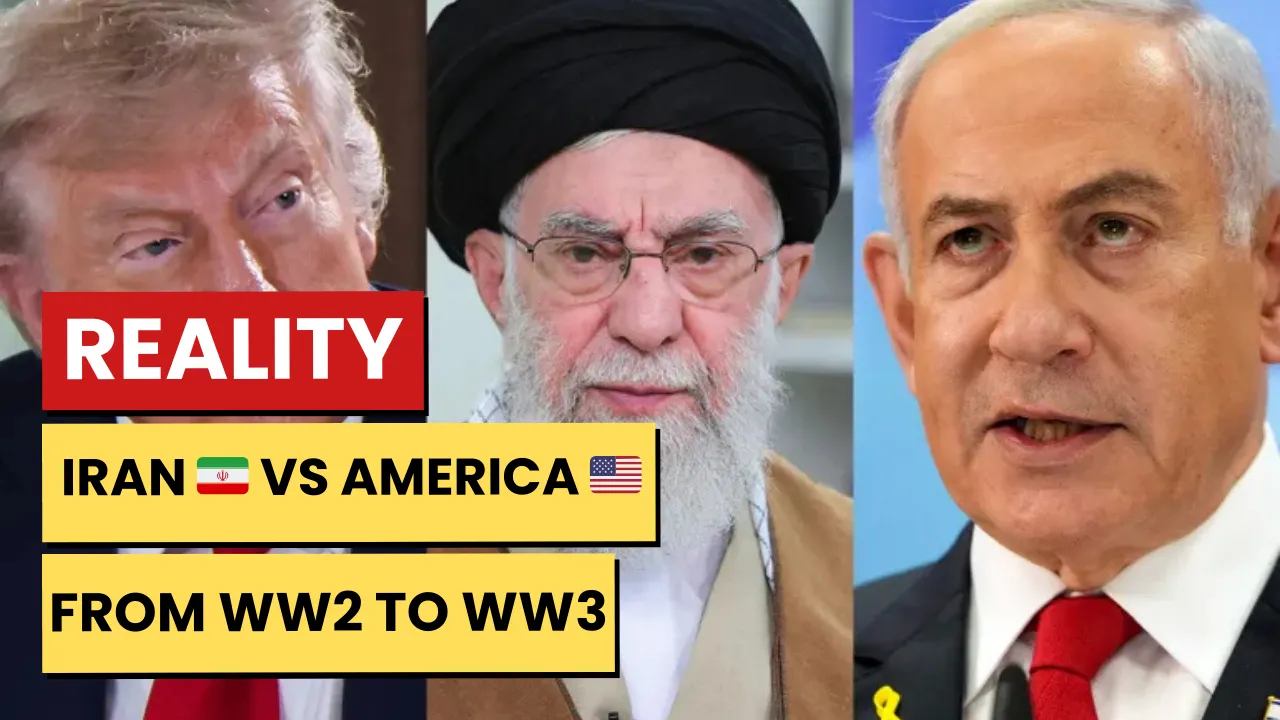
Iran, America, and Israel – what is their fight really about? There are 57 Islamic countries in the world. But what is the reason that America and Israel, ignoring all of them, are after just one country, Iran? To fully understand this war between Iran and America, we need to go back. All the way to World War II.
World War II: The Foundation of Conflict
In World War II, every country in the world had only two options: either support the British Empire or support Hitler. Most countries of the world supported the British Empire. But at that time, the Shah of Iran abandoned the British Empire and sided with Hitler. After this, Iran and Germany began to become very close friends. And the British Empire did not like this at all. Therefore, Britain attacked Iran from all sides and began conquering all of Iran very rapidly. Seeing this, the Shah of Iran surrendered to the British Empire within a few days and began begging them to save his rule. The British Empire agreed but had one condition: he would have to step down from the throne of Iran and make his 22-year-old son the new Shah of Iran. Because this son, Reza Shah Pahlavi, was a loyal puppet of the British Empire.
The Westernization of Iran Under the Shah
This new Shah of Iran was very inspired by the West. He wanted the people of Iran to dress exactly like the West, throw parties like them, and forget all their traditions. Therefore, from the very first day, he tried to distance the people of Iran from Islam. He banned the hijab in Iran, closed many madrasas and mosques, started arresting major Islamic scholars of Iran, and in their place, spread music, parties, and alcohol throughout Iran. There came a time when so much alcohol was produced in Iran that an Islamic country like Iran started exporting alcohol to the world.
This Shah of Iran thought he was doing a great job. "I mean, to be us, you see, we are the King of Kings." He even once told Saudi's King Faisal, "Why are you living in the old times? You should also make Saudi a liberal country, just like the West." But Saudi's King Faisal refused to do so. The funny thing here is that today, the same Saudi tells Iran, "You should also become a little liberal." But now Iran doesn't listen to them.
The Rise of Khomeini
The Shah tried so hard to distance Iran from Islam that all the major Islamic scholars of Iran began to turn against him. These scholars started giving speeches against the Shah in Iran's mosques and madrasas. The name of the greatest scholar among them was Ayatollah Khomeini. Khomeini and his followers began inciting the people of Iran to rebel against the Shah. Eventually, Khomeini's power grew so much in Iran that the Shah arrested him and exiled him from Iran forever.
After this, Imam Khomeini left Iran and started living in Iraq. There, a young leader was carefully noting his every move: Saddam Hussein. Gradually, Saddam Hussein also began to fear Khomeini's power. He even one day told the Shah of Iran, "If you want, I can finish Khomeini and shoot him," which was a very common thing for Saddam. But the Shah of Iran said, "No, there's no need to kill him. This old man Khomeini cannot harm me."
The Revolution and the Exile of the Shah
Imam Khomeini, sitting in Iraq, started recording his speeches on cassettes. These were then very secretly smuggled and spread throughout Iran. People were so inspired by listening to Khomeini's words that they gradually began to consider Imam Khomeini their leader more than the Shah. But still, removing the Shah of Iran was no easy task because he had a very dangerous army and the full support of the superpower, America. America supported him, and he was America's favorite puppet in the Muslim world.
But when the Shah of Iran was at the peak of his power, he made the biggest mistake of his life.
The Celebration That Backfired
Suddenly, one day the Shah of Iran announced a grand party to revive the great Persian Empire. It was to be the world's biggest and most expensive party in the deserts of Iran. World leaders and big celebrities were invited. A new city was built in the middle of the Iranian desert for this party. For his VIP guests, the Shah imported 600 limousines. He served food on gold plates. After this, the Shah had everyone stand before him and sat on his golden throne, proclaiming himself the new Emperor of the Empire.
But while the Shah of Iran was living a life of decadence, the poor people of Iran began to think: "We are struggling for basic necessities, and our Shah eats from gold plates." Therefore, after this party, the people of Iran rapidly moved towards Imam Khomeini's ideology. Khomeini declared in his cassettes that the Shah of Iran is the Yazid of this era.
The Fall of the Shah and the Rise of the Islamic Republic
Gradually, Khomeini became so powerful in Iran that the Shah of Iran realized only one power could now save him: the superpower, America. So, just like his father, he went to beg the superpowers. After this, the presidents of America, France, and other countries held a very important meeting. At the end of this meeting, they clearly told the Shah of Iran, "Now no one can save you from Khomeini." Hearing this, the Shah of Iran fled his country forever.
As soon as Khomeini learned that the Shah had fled Iran out of fear of him, Imam Khomeini, after 14 years in exile, finally set out for Iran. Never in the history of the world had so many people gathered for any leader as gathered to welcome Imam Khomeini. Seventy million people welcomed Imam Khomeini in Iran. This was a world record. As soon as Khomeini arrived in Iran, for the first time, slogans of "Death to America" and "Death to Israel" were raised on Iranian soil.
Khomeini's followers arrested all the personnel of the American embassy. Khomeini said, addressing the American President, "I will not release these 50 people until you hand over the Shah of Iran to us." And here began the enmity between America and Iran for the first time. But the Shah of Iran never returned to Iran. After his death, his son declared himself the new Shah of Iran.
Now in Iran, Khomeini established his new Islamic government. But at the same time that Khomeini became the leader of Iran, a new leader also emerged in Iraq, right next to Iran: Saddam Hussein.
The Iran-Iraq War
The problem here was that the other leaders of the world were very afraid of Khomeini's power. Because Khomeini repeatedly urged the people of the rest of the Muslim world in his speeches to rebel against their own kings. Seeing this, on the urging of America and Arab leaders, Saddam Hussein attacked Khomeini. A very severe war raged between Iran and Iraq for 8 years. But even with the support of the whole world, Saddam Hussein could not remove Khomeini from his throne. Finally, after 8 years, as soon as this war ended, shortly thereafter, Imam Khomeini passed away from this world.
Khomeini's funeral was the largest funeral in the history of the world, with 10 million people attending. To this day, it is recorded in the Guinness Book of World Records as the largest gathering for any leader. After this, Iran's ministers collectively chose their new leader after Khomeini: Ayatollah Khomeini's student, Ayatollah Ali Khamenei, who remains the Supreme Leader of Iran to this day.
The Quest for Nuclear Technology
After the war with Iraq ended, Iran's leaders understood that America and Israel would never stop pursuing them until Iran had its own atomic bomb. But the problem was that building an atomic bomb was no easy task. It's a very difficult technology, and at that time, no one was willing to give this technology to Iran. So Iran was waiting for some miracle where a country in the world would help them build an atomic bomb. And strangely enough, exactly that happened.
Right next to Iran, Pakistan, the world's first Islamic country, built its first atomic bomb. After Pakistan built its atomic bomb, A.Q. Khan very secretly began sending centrifuge technology to Iran to help them build their own atomic bomb.
For building an atomic bomb, the centrifuge machine is the most important thing. In simple words, it spins just like a washing machine. But instead of clothes, uranium is placed inside it. If uranium is kept in this machine for a short time (up to 5% enrichment), it produces electricity. But if uranium is kept spinning in this machine for a very long time (up to 90% enrichment), it produces an atomic bomb.
Using this technology from Pakistan, Iran rapidly started building nuclear plants. But as soon as Iran started doing this, somehow America got wind of it. America could, to some extent, accept Pakistan's atomic bomb because Pakistan is a very loyal country to America. "Choose, we have to feed our nation." And whatever happens, Pakistan never goes against America. Because Pakistan and America are very old friends. "Be with my friend." But Iran is completely opposite to Pakistan; it repeatedly looked America in the eye and threatened it.
The "Axis of Evil" and Its Aftermath
As soon as America found out about Iran's project, the American President appeared before the whole world and said in his speech, "There are some countries in the world that want to build chemical and atomic bombs for themselves. One is Iraq's Saddam Hussein, and the other is Iran's Khamenei." Which the whole world today knows was a huge lie. Bush's mistake.
Shortly after George Bush's speech, America attacked Saddam Hussein and, after killing thousands of people in Iraq, ended Saddam's rule. After dismantling Saddam Hussein's rule so easily, America realized that it could accuse any country in the world falsely and attack it. Therefore, after the attacks on Afghanistan and Iraq, America's next target was Iran. America repeatedly began lying again that Iran had atomic bombs.
Now the eyes of the whole world were on Iran's leader, Ayatollah Khamenei. And this was the best time to attack Iran because on one side of Iran, in Afghanistan, there was a huge American army, and on the other side of Iran, Iraq was also filled with the American army. Meaning America had surrounded Iran from all sides. So now the whole world watched to see how Iran's leader, Ayatollah Khamenei, would save his country from the superpower, America.
The Fatwa Against Nuclear Weapons
And here, Khamenei said something that broke all of America's excuses for attacking Iran. Khamenei, who is a great scholar of the Islamic world, issued a fatwa stating that building an atomic bomb is haram (forbidden) for Muslims in Islam. Because Islam teaches us that even on the battlefield, no child, elderly person, or woman can be killed. Even during war, cutting down trees is not permitted. But an atomic bomb is something that destroys everything without distinction. Therefore, Iran's Khamenei declared the atomic bomb absolutely haram for Muslims. At the same time, he announced that Iran had no intention of building an atomic bomb, and opened Iran's doors for everyone, declaring that any agency in the world could come to Iran and see for itself that Iran had no intention of building an atomic bomb.
The A.Q. Khan Network Exposed
The UN team went to Iran and saw that all of Iran's nuclear plants were built on exactly the same design as those built in Pakistan. The whole world understood that Iran had bought this technology from Pakistan. Pressure mounted so much on Pakistan that A.Q. Khan himself appeared on TV, accepted this, and apologized to everyone. "Much it is true." To appease the world, Pakistan arrested A.Q. Khan and confined him to his own home.
Sanctions and the Nuclear Deal
After Khamenei's fatwa, America no longer had any excuse to attack Iran. But there was one country in the world that repeatedly pressured America to attack Iran: Israel. America did not listen to Israel. But gradually, circumstances began to change.
A very important man from Iran, sitting in France, wrote a very strange thing: that Ayatollah Khamenei's fatwa declaring the atomic bomb haram is a false fatwa, and he is hiding behind an Islamic concept called "Taqayya." In Islam, Taqayya means that a person can lie to save their life. So this man said that Khamenei gave this false fatwa to save the lives of the people of Iran. And this man, Mahmoud Moradkhani, was no ordinary person. He is the son of Khamenei's sister. Meaning, he was his own nephew. Khamenei's sister and this son are among his biggest enemies in Iran.
Around these same days, America's suspicion of Iran also grew. Finally, in 2009, America imposed very strict sanctions on Iran. Look at this graph. Before America's sanctions, Iran's economy was rising very rapidly. But as soon as America imposed sanctions, Iran's entire economy collapsed. After these sanctions, a country as rich in oil and gas as Iran began to go bankrupt. Without America's permission, Iran cannot sell its gas to anyone in the world. Even after making a deal with its close neighbor Pakistan, Pakistan does not buy gas from Iran. Abandoning cheap Iranian gas, it imports expensive LNG from faraway Qatar. This is like someone, fearing a big bully, avoids buying from the shop near their home and goes far away every day to buy expensive things. Only three big countries in the world still do business with Iran today: China, Russia, and India.
The JCPOA (Iran Nuclear Deal)
Due to America's sanctions, Iran's conditions became so bad that the Iranian government became willing to deal with America. Finally, with American President Barack Obama, Iran made a nuclear deal: an understanding that Iran would not build an atomic bomb, and in return, America would remove all sanctions from Iran, and Iran's economy would become strong again. This was a great achievement for both countries. But from day one, there was one person in America who was strictly against this deal: Donald Trump. Trump was against this deal because of the very large network of Jews in America, without whose support no one can do anything in America.
Trump's Withdrawal and "Maximum Pressure"
Therefore, shortly after winning his first elections, Donald Trump ended the deal made with Iran and once again imposed strict sanctions on Iran to weaken its economy, causing Iran's economy to plummet once again. But of course, Iran is Iran. It was not going to remain silent out of fear like the rest of the Muslim world. As soon as Trump imposed sanctions, Iran restarted its nuclear program.
On the other hand, everyone knows Donald Trump does not tolerate defiance from anyone except himself. When Iran looked America in the eye, Donald Trump, to teach them a lesson, suddenly one day, in a missile strike, killed Iran's Army Chief, Qasem Soleimani. This was a great humiliation for Iran and its people, that someone could so easily kill their army chief in front of the whole world. Gradually, anger against America began to rise in Iran.
Ebrahim Raisi's Presidency
As soon as new elections were held in Iran after Soleimani's death, a new president came in the next elections: Ebrahim Raisi. He was a very strict president of Iran, not ready to bow down to America and Israel under any circumstances. As soon as Ebrahim Raisi became president, Iran's nuclear program started increasing again. And upon becoming president, he made it very clear that Iran would not make any deal with America. Along with this, they started funding and sending weapons to all the groups fighting against Israel. And it was during his time that the conflict between Israel and Gaza escalated.
But we all know what happens when any leader speaks so openly against America and Israel. President Raisi died when his helicopter crashed.
Current Situation: Moderate President and Renewed Diplomacy
After Raisi's departure, elections were held again in Iran about a year ago, in which the people of Iran chose a leader completely opposite to Ebrahim Raisi, a very soft and calm person. Upon becoming president, he first announced, "We still stand firmly with the same fatwa of Ayatollah Khamenei, and Iran will never build an atomic bomb." He also said that Iran is ready to deal with America, in fact, with the whole world.
Very secretly, not too long ago, meetings started happening again between America and Iran for a potential new deal. But Israel never wants America and Iran to make a deal. Israel began trying every possible way. After this, Israel once again started making false accusations against Iran: "Iran has never given up its quest for nuclear weapons." "Iran is going to make an atomic bomb within a month." "It could be within a few months." Something they have been doing for the last 25 years. What kind of atomic bomb is this that has been "about to be made in one month" for the last 25 years but still hasn't been made? Israel also accused Iran of repeatedly trying to kill American President Donald Trump.
Israel's Current Campaign
Therefore, today Israel is attacking Iran, picking off every single person in Iran who wants to make a deal with America. Through these attacks, Israel is trying to provoke Iran into angrily taking a wrong step, so that the superpower America would attack Iran, and the government of Ayatollah Khomeini, established many years ago, would finally fall. Subscribe.
Sources for NazaraCircle.com
1. Historical Events (WWII, 1953 Coup, Revolution):
- General Historical Knowledge: The overview of World War II alliances and the Allied invasion of Iran in 1941 is well-documented history.
- The 1953 Iranian Coup d'état: The overthrow of Prime Minister Mohammad Mossadegh and the strengthening of the Shah's rule was orchestrated by the CIA and MI6. This is a crucial backdrop, even if not mentioned by name, to understanding the Shah's dependence on the West. Declassified CIA documents and books like "All the Shah's Men" by Stephen Kinzer are key sources.
- The Shah's Reign and Westernization: Biographies of Mohammad Reza Pahlavi and historical accounts of his "White Revolution" detail his efforts to modernize and secularize Iran, including policies on dress, the role of the clergy, and economic development.
- Ayatollah Khomeini's Life and Exile: Biographies of Khomeini, his speeches, and historical accounts of his time in Iraq and France are sources. The narrative of his cassette tapes being smuggled into Iran is a well-known part of the revolutionary story.
- The 2,500-year Celebration of the Persian Empire: This event is a matter of historical record. News reports, photographs, and accounts from attendees detail the extravagance of the celebration at Persepolis in 1971.
- The Iranian Revolution (1979): Countless books, documentaries, and news archives (like those from BBC and ABC News) cover the events leading to the Shah's departure, Khomeini's return, and the hostage crisis at the US Embassy. The footage of millions greeting Khomeini is iconic.
2. The Iran-Iraq War (1980-1988):
- Historical analyses of the war, including the role of international support for Saddam Hussein. The fear of Iran's revolutionary export is a common theme in political science literature on the period.
3. Nuclear Program and Pakistan's Role:
- A.Q. Khan Network: The story of Pakistani scientist A.Q. Khan proliferating centrifuge technology to Iran, Libya, and North Korea is well-documented. It was investigated by the IAEA (International Atomic Energy Agency) and reported extensively by news outlets like The New York Times, The Guardian, and The Wall Street Journal. A.Q. Khan's own televised confession is a primary source.
- Khamenei's Fatwa on Nuclear Weapons: The existence of the fatwa has been reported by official Iranian sources and international media. Statements from Iranian officials reiterating the fatwa are a primary source.
4. Post-9/11 and the "Axis of Evil":
- President George W. Bush's "Axis of Evil" Speech: This is a direct primary source from his 2002 State of the Union address.
- US Sanctions on Iran: Information on the timeline and impact of US sanctions is available from the US Treasury Department, as well as economic analysis from institutions like the IMF and World Bank.
- The JCPOA (Iran Nuclear Deal): The negotiations and final agreement between the P5+1 (US, UK, France, Russia, China, Germany) and Iran are a matter of public record. Statements from all participating governments are primary sources.
- Opposition to the JCPOA: The strong opposition from Israeli leaders (like Benjamin Netanyahu) and pro-Israel lobbying groups in the US (like AIPAC) is a well-covered aspect of the political debate.
5. Recent Events (Trump Era to Present):
- President Trump's Withdrawal from the JCPOA: This was a formal policy announcement.
- "Maximum Pressure" Campaign: Information on the re-imposition of sanctions is from official US government announcements.
- Assassination of Qasem Soleimani: This was a major international news event, covered by every major news outlet. The Pentagon's official statement and reactions from Iranian and Iraqi officials are primary sources.
- Ebrahim Raisi's Presidency: His election, statements, and policies were covered extensively by international news media (Al Jazeera, BBC, Reuters, etc.). His death in a helicopter crash was also a major news event.
- Current Leadership and Stance: Statements by the current president (Masoud Pezeshkian) and Supreme Leader Khamenei regarding the fatwa, nuclear policy, and willingness to negotiate are reported by news agencies like Reuters, AP, and Iranian state media (like Press TV, though its reliability is debated).
- Israeli Operations in Iran: Reports on suspected Israeli operations, assassinations of Iranian nuclear scientists, and sabotage are often attributed to anonymous intelligence sources and reported by outlets like The New York Times and The Wall Street Journal, as well as Israeli media.
6. Geopolitical Analysis:
- Think tanks and policy institutes (like the Council on Foreign Relations, Chatham House, International Crisis Group) provide detailed analysis on the US-Iran-Israel triangle.
- Analysis of the relationship between Pakistan, the US, and Iran is based on historical diplomatic records and contemporary reporting on their interactions.




No comments yet. Be the first to comment!